


Beyond Cholesterol
Understanding Apolipoprotein A‑I, Apolipoprotein B and Lipoprotein(a) Testing
By Dr Eric Law
Published July 2026
Key Messages
- LDL-C measures cholesterol content, not particle number. ApoB provides a directe stimate of total atherogenic particle burden.
- Discordance matters. When LDL-C and ApoB differ, cardiovascular risk appears to align more closely with ApoB.
- ApoA-I reflects protective HDL biology, and the ApoB/ApoA-I ratio captures overall lipoprotein balance.
- Lp(a) is an inherited, independent cardiovascular risk factor affecting approximately one in five individuals and is generally stable over a lifetime.
- A single Lp(a) measurement is usually sufficient, particularly in those with premature cardiovascular disease or strong family history.
- Management remains focused on aggressive control of modifiable risk factors, especially LDL-C, blood pressure, smoking, and glycaemic status, given the current absence of widely available Lp(a)-specific therapies.
Are we missing cardiovascular risk?
Heart disease remains one of the leading causes of death in Australia and worldwide. Many people at risk are unaware of it. Even when a standard cholesterol test appears “normal,” cardiovascular risk may still be present. Why?
Cardiovascular Risk Beyond the Standard Lipid Panel
Cardiovascular disease remains one of Australia’s leading causes of death, accounting for approximately one in four deaths nationally. In everyday clinical practice, risk assessment relies heavily on the standard lipid panel: total cholesterol, LDL cholesterol (LDL-C), HDL cholesterol and triglycerides.
LDL-C, however, measures the amount of cholesterol carried within LDL particles, not the number of atherogenic particles themselves. This distinction matters. Two individuals with identical LDL-C levels may have very different numbers of LDL particles circulating in the bloodstream. Because atherosclerosis is driven by the entry and retention of lipoprotein particles within the arterial wall, particle number carries strong biological relevance; hence, apolipoprotein testing offers a practical way to explore this dimension of risk.
Apolipoprotein B: Measuring Atherogenic Particle Burden
Apolipoprotein B (ApoB) is the major structural protein of LDL and other atherogenic lipoproteins. Critically, each atherogenic particle contains exactly one ApoB molecule, so ApoB concentration directly reflects the total number of circulating atherogenic particles.
Why the Difference Matters
Consider two patients with the same LDL-C level (see Figure 1). The first has fewer, larger LDL particles, each carrying more cholesterol but with fewer opportunities to penetrate and become retained in the arterial wall. The second has many smaller LDL particles, each carrying less cholesterol. Total LDL-C is identical, yet the greater particle count increases the probability of arterial wall penetration and retention, driving plaque formation.
Figure 1. Schematic Diagram: LDL-C vs LDL Particle Number (LDL-P)
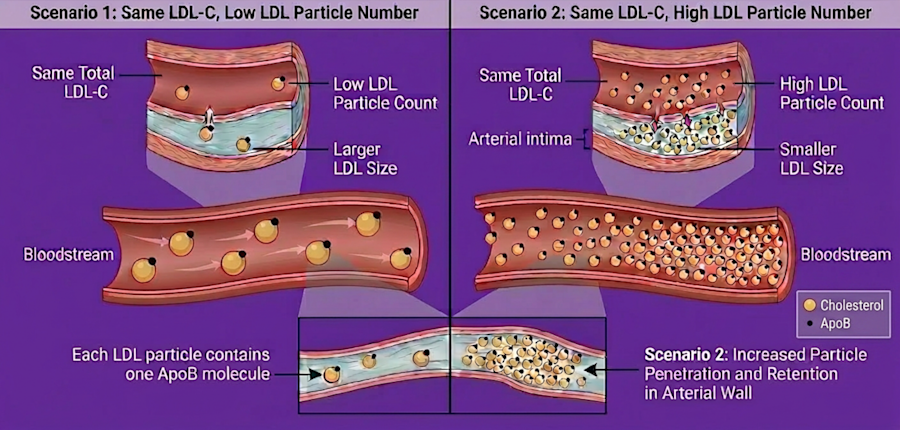
In Scenario 1, there are fewer, larger LDL particles, each carrying a greater amount of cholesterol. Because there are fewer particles (low LDL-P), there are fewer opportunities for particles to enter and become retained within the arterial wall. In Scenario 2, there are many small LDL particles, each carrying less cholesterol. Although total LDL-C is the same, the number of circulating LDL particles (high LDL-P) is greater. This distinction underpins the clinical value of measuring ApoB, which reflects total LDL particle number rather than cholesterol content.
The Royal College of Pathologists of Australasia (RCPA) notes that ApoB serves as a measure of atherogenic lipoprotein burden, and accumulating evidence suggests that ApoB and non-HDL cholesterol may be superior to LDL-C in predicting atherosclerotic cardiovascular disease risk.
This becomes particularly relevant when LDL-C and ApoB are discordant. A patient may have an LDL-C within the target range but an elevated ApoB, indicating a higher particle burden, and cardiovascular risk appears to align more closely with ApoB in these cases.
The RCPA recommends ApoB targets of less than 1.00 g/L for individuals at high cardiovascular risk and less than 0.80 g/L for those at very high risk.
Apolipoprotein A-I: The Protective Counterpart
Apolipoprotein A-I (ApoA-I) is the principal structural protein of HDL cholesterol and plays a central role in reverse cholesterol transport, facilitating the removal of cholesterol from peripheral tissues and its return to the liver for processing.
As the RCPA notes, ApoA-I and HDL levels are inversely related to atherosclerotic cardiovascular disease risk. While ApoA-I is less commonly used than ApoB in routine clinical decision-making, it represents the protective side of the lipoprotein profile. Reduced ApoA‑I levels are commonly associated with an increased risk of atherosclerosis and coronary artery disease. Although measuring ApoA‑I concentration offers useful information for cardiovascular risk assessment, the functional integrity of the protein is equally important. In states of chronic, significant inflammation, ApoA‑I may undergo oxidative modification or become dysfunctional, diminishing its protective effects on the vascular endothelium.
HDL cholesterol (HDL-C) is well known and is commonly used in cardiovascular risk assessment, but it measures only the cholesterol content within HDL particles, not the number of particles present. Apolipoprotein A-I (ApoA-I), the main structural protein of HDL, provides a better estimate of HDL particle concentration and reflects reverse cholesterol transport capacity. As a result, two individuals with the same HDL-C may differ in HDL particle number or composition, and potentially in cardiovascular risk. ApoA-I measurement may be helpful when lipid markers are discordant, when calculating the ApoB/ApoA-I ratio, or when additional risk stratification is needed. Nonetheless, HDL-C is sufficient for routine assessment in most patients, and ApoA‑I testing is generally reserved for specific clinical situations rather than used routinely.
A helpful way to understand the difference is to think of HDL cholesterol (HDL-C) as measuring the amount of cholesterol being transported, while ApoA‑I reflects the main structural protein that makes up the HDL particles themselves, similar to estimating how many carriers are available to transport that cholesterol. Two people may have comparable HDL-C levels but differ in the number or composition of their HDL particles.
This distinction can matter, as HDL particle numbers may, in certain situations, provide additional information about cardiovascular risk beyond cholesterol content alone. Measuring ApoA-I can therefore offer complementary insight when refining CVD risk assessment. ApoA-I levels generally track with HDL levels, and low ApoA-I concentrations are associated with a higher risk of cardiovascular disease.
The ApoB/ApoA-I ratio captures the balance between atherogenic and protective particles. A higher ratio reflects a predominance of atherogenic lipoproteins relative to HDL-associated protective capacity and has been associated with increased cardiovascular risk in large cohort studies.
Lipoprotein(a): An Inherited and Independent Risk Factor
Lipoprotein(a), or Lp(a), is composed of an LDL‑like particle attached to apolipoprotein(a), a protein encoded by the highly polymorphic LPA gene. A defining characteristic of Lp(a) is the marked variability in the size of apolipoprotein(a), driven by differences in the number of kringle IV type 2 repeat sequences within the gene. This genetic polymorphism results in more than 40 isoforms of apolipoprotein(a), leading to substantial inter‑individual variation in Lp(a) particle size and circulating concentration.
Table 1. Interpretation of Apolipoprotein and Lipoprotein(a) Results

| Marker | Abnormal Finding | Potential Clinical Implication |
|---|---|---|
| ApoB | High | Increased atherogenic particle burden |
| ApoA‑I | Low | Reduced protective lipoprotein capacity |
| ApoB/ApoA‑I | High | Higher net atherogenic balance |
| Lp(a) | High | Increased cardiovascular risk |
Lp(a) has been identified within the arterial wall and is thought to contribute to the development of atherosclerosis. Because apolipoprotein(a) is structurally similar to plasminogen, Lp(a) may interfere with normal fibrinolysis and promote a pro‑thrombotic state. Elevated circulating Lp(a) levels are associated with earlier onset of atherosclerosis and an increased risk of stroke. When high Lp(a) concentrations occur alongside elevated LDL cholesterol, the risk of coronary heart disease increases markedly, by approximately six‑fold.
Lp(a) concentrations are predominantly genetically determined and generally remain stable over a person’s lifetime. They are not significantly influenced by age, sex, diet, physical activity or most conventional lipid‑lowering therapies. Elevated Lp(a) is recognised as an independent, inherited causal risk factor for atherosclerotic cardiovascular disease, calcific aortic valve stenosis, cardiovascular mortality and all‑cause mortality.
Because of the marked isoform variability of Lp(a), measured Lp(a) levels—as well as reference intervals and clinical cut-offs—depend on the assay methodology used. Please refer to the reference ranges and commentary found on your pathology report.
Australian commentary has increasingly highlighted Lp(a) as an under-recognised contributor to cardiovascular risk. Lp(a) is described as a “mystery cholesterol” absent from routine lipid testing, meaning it may go undetected in standard assessments. The FH Australasia Network estimates that approximately one in five individuals has elevated Lp(a), and first-degree relatives of affected individuals have a 50% likelihood of sharing the trait.
When Apolipoprotein Testing May Be Informative
ApoB and Lp(a) testing are particularly valuable when the standard lipid panel does not fully account for a patient’s clinical picture. Situations worth considering include:
- Premature cardiovascular disease or a strong family history of early events
- Residual risk despite LDL-C at target
- Suspected familial hypercholesterolaemia
- Discordance between LDL-C and non-HDL cholesterol
Additional testing should meaningfully refine risk stratification and support clinical decision-making, as it complements rather than replaces established risk tools (see Table 1).
Clinical Implications
Management decisions should remain individualised and guided by current clinical guidelines. In general terms:
- Elevated ApoB supports optimisation of LDL-lowering strategies to reduce total atherogenic particle burden.
- Elevated Lp(a) underscores the importance of aggressively addressing all modifiable risk factors, including LDL-C, blood pressure, glycaemic control and smoking, given the absence of approved Lp(a)-specific therapies in routine practice.
Standard lipid testing remains fundamental to cardiovascular prevention. Apolipoprotein testing extends this foundation by shifting the focus from cholesterol quantity to particle number, particle balance and inherited risk. Interpreted thoughtfully and in clinical context, ApoB, ApoA-I and Lp(a) can meaningfully refine risk assessment and support more individualised prevention strategies.
Conclusion
Cardiovascular risk assessment in Australia continues to rely primarily on the standard lipid panel. While LDL-C remains central to prevention strategies, it reflects cholesterol mass rather than the number of circulating atherogenic particles. Increasing evidence and contemporary expert consensus highlight that particle number, reflected by ApoB, may more closely align with atherosclerotic risk, particularly when traditional markers appear discordant.
ApoA-I provides insight into the protective component of the lipid profile, and the ApoB/ApoA-I ratio captures the balance between atherogenic and anti-atherogenic forces. Lipoprotein(a), meanwhile, represents a distinct and inherited risk factor that is not detected on routine lipid testing.
Together, these markers deepen our understanding of lipid biology and help explain why some patients experience cardiovascular events despite “acceptable” LDL-C levels, while others with similar cholesterol values remain event-free. Importantly, apolipoprotein testing is not intended to replace absolute cardiovascular risk assessment tools, but to refine them when clinical uncertainty, discordance or inherited risk is suspected.
In clinical practice, apolipoprotein testing should be used thoughtfully; not routinely for all patients, but strategically when it adds clarity. Moving beyond cholesterol quantity to particle number and inherited risk enables a more nuanced and individualised approach to cardiovascular prevention.
How to Order Apolipoprotein Testing
Complete the Clinical Labs general pathology request form. For referrers in WA, please use the WA Request Form.
Apolipoprotein A-I or apoA-1
Apolipoprotein B or apoB
Lipoprotein(a) or Lp(a)
Note: If both apoA-1 and apoB are requested, the apoA-1/apoB ratio will be provided.
Include cardiovascular risk and family history, if known.
SST (serum)
There are no MBS item numbers available for these tests. Current out-of pocket pricing and payment information is available at pay.clinicallabs.com.au.
Note that ACL offers discounted pricing when ApoA1 and ApoB are requested together.
Lipid Profile+HDL
References
- Royal College of Pathologists of Australasia (RCPA). Apolipoprotein B. RCPA Manual. Available at: https://www.rcpa.edu.au/Manuals/RCPA-Manual/Pathology-Tests/A/Apolipoprotein-B
- Royal College of Pathologists of Australasia (RCPA). Apolipoprotein A I. RCPA Manual. Available at: https://www.rcpa.edu.au/Manuals/RCPA-Manual/Pathology-Tests/A/Apolipoprotein-A-I
- Royal College of Pathologists of Australasia (RCPA). Lipoprotein(a). RCPA Manual. Available at: https://www.rcpa.edu.au/Manuals/RCPA-Manual/Pathology-Tests/L/Lipoprotein-(a)
- NSW Health Pathology. Raising awareness of ‘mystery’ cholesterol – Lp(a). 30 March 2026. Available at: https://pathology.health.nsw.gov.au/articles/raising-awareness-of-mystery-cholesterol-lpa/
- FH Australasia Network. Lipoprotein(a). Available at: https://www.athero.org.au/fh/lipoproteina/
- Burge K. Heart health risk ‘hidden’ without routine testing: Study. newsGP (RACGP). 21 August 2025. Available at: https://www1.racgp.org.au/newsgp/clinical/heart-health-risk-hidden-without-routine-testing-s
- Liotta M. Heart attack risk: Is expanded cholesterol testing warranted? newsGP (RACGP). 31 January 2023. Available at: https://www1.racgp.org.au/newsgp/clinical/heart-attack-risk-is-expanded-cholesterol-testing
- Australian Institute of Health and Welfare (AIHW). Heart, stroke and vascular disease: Australian facts. 2025. Available at: https://www.aihw.gov.au/reports/heart-stroke-vascular-diseases/hsvd-facts/contents/about
- Soffer DE, et al. Role of apolipoprotein B in the clinical management of cardiovascular risk in adults: An Expert Clinical Consensus from the National Lipid Association. J Clin Lipidol. 2024;18(5):e647-e663.
- Morton JI, et al. Lp(a) International Taskforce (ITF) initiative. Lp(a) testing for the primary prevention of cardiovascular disease in high-income countries: a cost-effectiveness analysis. Atherosclerosis. 2025;409:120447.
About the Author

Dr Eric Law
MBChB BMedSc(1st Hon) PhD FHKAM(Pathology) FHKCPath FRCPA FRCPath FAACB FFSC(Research) IFCAPDr Eric Law
MBChB BMedSc(1st Hon) PhD FHKAM(Pathology) FHKCPath FRCPA FRCPath FAACB FFSC(Research) IFCAP- biochemical genetics
- chemical pathology
- inherited metabolic disorders
Dr Law completed his medical science degree (first honor) and MB ChB at the Chinese University of Hong Kong and obtained his PhD from the University of Hong Kong. He is a Fellow of the Royal College of Pathologists of Australasia (FRCPA), with scope of practice in both Chemical Pathology and Genetic Pathology. Additionally, he is a Fellow of the Australian Association of Clinical Biochemists (FAACB), the Royal College of Pathologists (FRCPath), an International Fellow of College of American Pathologists (IFCAP), Hong Kong College of Pathologists (FHKCPath), Hong Kong Academy of Medicine (FHKAM(Pathology)) and the Faulty of Science (Research), RCPA. His areas of interest include chemical pathology, inherited metabolic disorders, clinical metabolomics and medical teaching.
Local Pathologists
 Pathologist

 Pathologist
Related Pages

Optimising Cardiac Care
Associate Professor Harry G Mond and Clinical Labs chemical pathologist Dr David Deam explore key investigative tests that GPs can order for patients presenting with cardiac symptoms in general practice.

PGx Testing for Optimised Drug Treatment Outcomes
Associate Professor Mirette Saad explores how Pharmacogenetic testing supports precision medicine by helping clinicians optimise drug selection, dosing and patient safety across key therapeutic areas.

Understanding BNP Testing
Dr David Deam highlights the clinical utility of a new Medicare item number for BNP testing for the exclusion of a diagnosis of heart failure, which broadens the range of clinical situations in which the test can be ordered.